
Rejecting the Industrial Broker Supply Chain
Eliminating Commercial Brokers: Direct Partnerships
Eliminating Commercial Brokers: Direct Partnerships
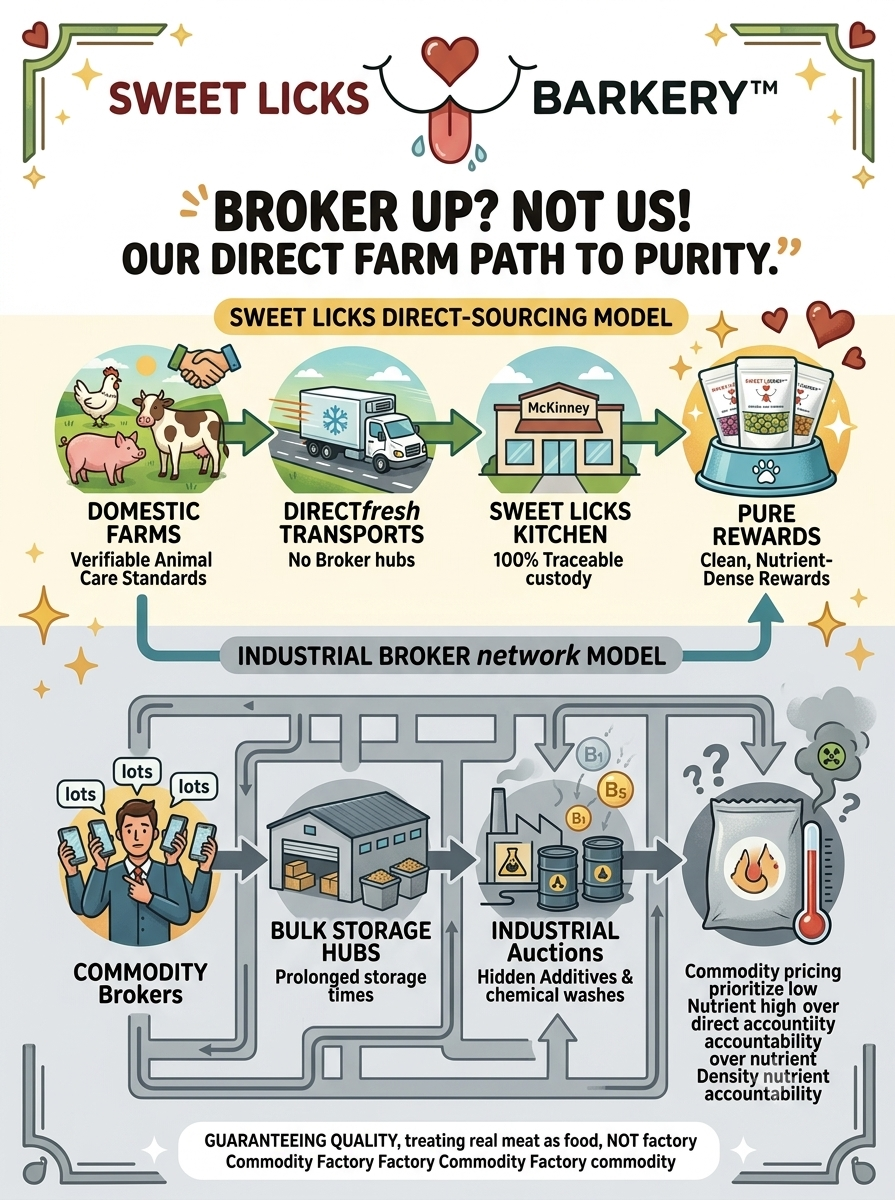
To truly understand the purity of a companion animal reward, we must follow the ingredient trail back past the kitchen doors and look closely at how raw materials are bought and sold. The vast majority of mass-market pet food brands do not have direct relationships with the farms that grow their ingredients. Instead, they purchase bulk components through a complex network of industrial commodity brokers (Martinez et al., 2010).
These brokers purchase excess materials from high-confinement facilities and combine them into massive commercial lots. This industrial trading model treats food as a basic commodity, prioritizing low cost over nutrient density and direct accountability. At Sweet Licks Barkery, we choose to completely bypass this broker network, establishing direct, transparent partnerships with trusted domestic growers.
The Risks of Bulk Broker Accumulation
When raw ingredients are managed through commercial brokers, they are subjected to significant shipping lags and storage times. Materials from different facilities are combined into single lots, making it impossible to trace an ingredient back to a specific farm. This multi-step handling exposes raw proteins to prolonged storage in bulk holding areas, where environmental exposure can accelerate lipid oxidation and degrade natural heat-labile vitamins like Thiamin ($B_1$) and Pantothenic Acid ($B_5$) before manufacturing even begins (Raharjo & Sofos, 1993; Case et al., 2011).
Our direct-sourcing model completely eliminates these industrial vulnerabilities:
Farm-to-Pouch Traceability: By working directly with reputable domestic farms, we maintain a clear, uncompromised record of custody for every single ingredient that enters our kitchen.
Unmatched Raw Freshness: Bypassing broker hubs allows our raw proteins to move directly from sustainable pastures to our kitchen at peak biological freshness (Montegiove et al., 2022).
Eliminating Hidden Additives: Industrial brokers often use chemical stabilizers, chemical mold inhibitors, and sulfur washes to artificially extend the holding windows of raw meats. Direct sourcing ensures our meats arrive pure, clean, and entirely free from synthetic chemicals.
Prioritizing Integrity Over Commodity Pricing
Direct farm relationships allow our kitchen to verify the animal care standards, soil health, and processing quality of our ingredients first-hand. We treat raw meat as real, living food rather than a cheap factory commodity.
This direct approach ensures that your companion receives a clean, nutrient-dense reward completely free from hidden processing residues or low-grade fillers (Case et al., 2011). Rejecting the industrial broker network is a vital operational step that allows us to guarantee the absolute safety and unmatched quality of every treat we stamp.
References
Case, L. P., Daristotle, L., Hayek, M. G., & Raasch, M. F. (2011). Canine and Feline Nutrition: A Resource for Companion Animal Professionals (3rd ed.). Mosby Elsevier.
Martinez, S., Hand, M., Da Pra, M., Pollack, S., Ralston, K., Smith, T., Vogel, S., Newman, C., & Slattery, S. (2010). Local Food Systems: Concepts, Impacts, and Issues (ERR-97). U.S. Department of Agriculture, Economic Research Service.
Montegiove, N., Calzoni, E., Cesaretti, A., Pellegrino, R. M., Emiliani, C., Pellegrino, A., & Leonardi, L. (2022). The Hard Choice about Dry Pet Food: Comparison of Protein and Lipid Nutritional Qualities and Digestibility of Three Different Chicken-Based Formulations. Animals, 12(12), 1538. https://doi.org/10.3390/ani12121538
Raharjo, S., & Sofos, J. N. (1993). Lipid oxidation in oncology and agriculture meat products: A review. Meat Science, 35(2), 145-169. https://doi.org/10.1016/0309-1740(93)90051-G