
Factual Food Literacy: Defining the Legal Baseline of Natural
Factual Food Literacy: Defining the Legal Baseline of Natural
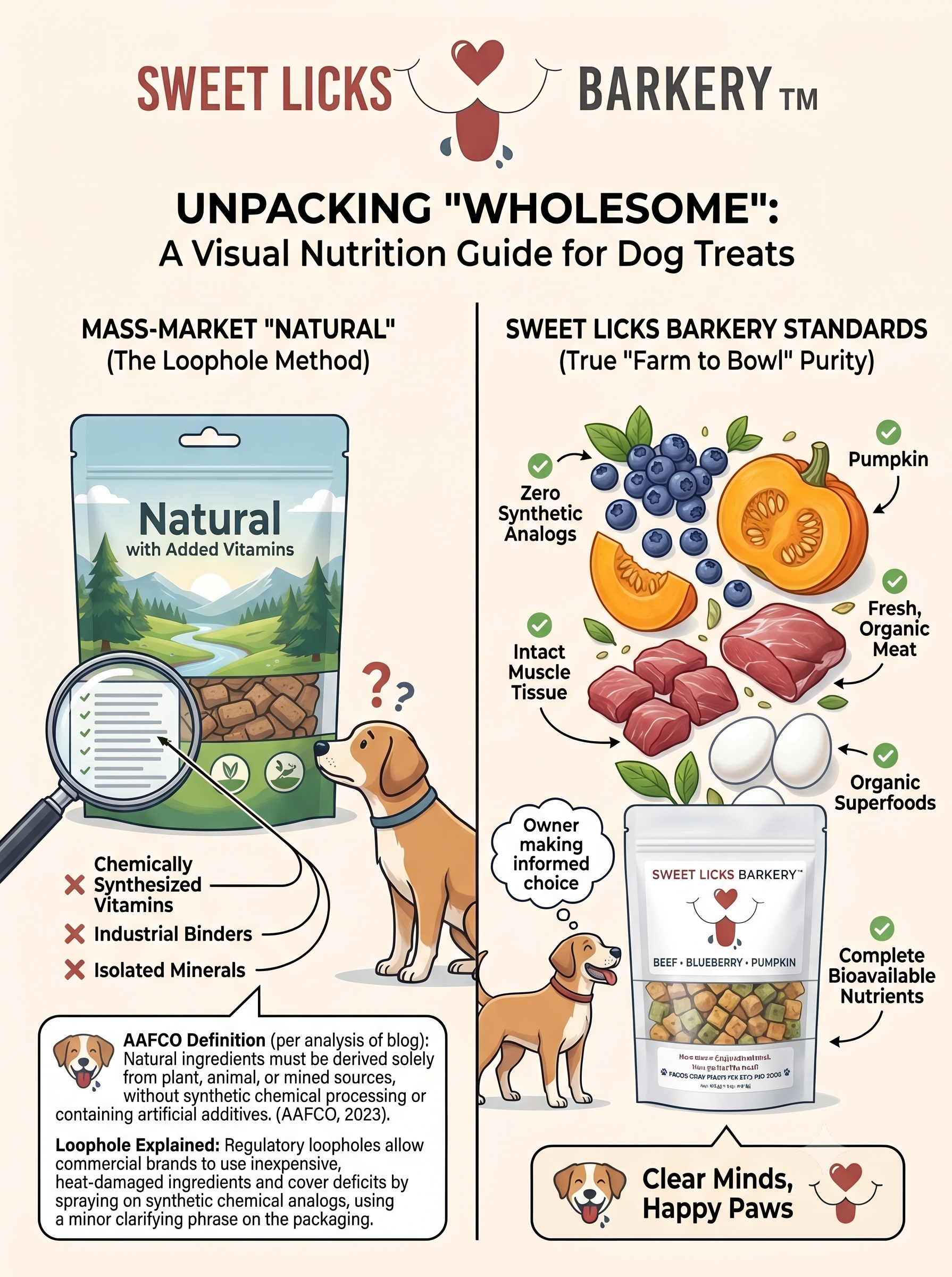
In the competitive world of pet care marketing, "wholesome" and "all-natural" are frequently utilized as eye-catching label catchphrases. Mass-market packaging often features illustrations of pristine natural landscapes to imply a standard of health that the ingredients themselves simply do not support. To make truly informed choices for our packs, we must look past this marketing imagery and examine the literal, legal definitions established by animal feed regulatory bodies (AAFCO, 2023).
According to AAFCO guidelines, a "natural" ingredient must be derived solely from plant, animal, or mined sources without undergoing synthetic chemical processing or containing artificial additives (AAFCO, 2023). While this definition establishes a helpful baseline, it contains significant regulatory loopholes that commercial brands exploit every day.
Navigating Regulatory Loopholes
Under standard feed definitions, a product can legally carry a "natural" label even if it utilizes chemically synthesized vitamins, mineral texturizers, and industrial binding agents, provided the manufacturer includes a brief clarifying phrase on the packaging, such as "Natural ingredients with added vitamins and minerals" (AAFCO, 2023). This allows mass-market brands to use inexpensive, heat-damaged ingredients and cover up the resulting nutritional deficits by spraying on synthetic chemical analogs (Case et al., 2011).
Sweet Licks Barkery goes far beyond this basic regulatory minimum, defining all-natural through our strict Farm to Bowl standards:
Zero Synthetic Analogs: We completely ban factory-synthesized vitamins and artificial texturizers from our kitchen, delivering pure, whole-food nutrition exactly as nature intended.
Unadulterated Muscle Tissues: Our recipes rely entirely on intact whole meats and fresh eggs that naturally supply a complete spectrum of essential amino acids, bioavailable iron, and zinc (Case et al., 2011; Montegiove et al., 2022).
Organic Superfood Antioxidants: We harvest our vitamins and trace minerals exclusively from vibrant, organic whole fruits and fibers like pumpkin and blueberries (Koppel et al., 2014).
Pure Food is Pure Medicine
When an animal ingests nutrients bound within their natural whole-food structures, their digestive system identifies and absorbs those elements with outstanding efficiency (Case et al., 2011). The body's cells are biologically optimized to process real food, not isolated chemical synthetics which can possess altered isomeric configurations and lower uptake coefficients.
By keeping our formulations literal, transparent, and completely free from industrial processing shortcuts, we deliver clean, honest rewards that support your pet's long-term wellness safely and naturally.
References
Association of American Feed Control Officials (AAFCO). (2023). Official Publication. AAFCO.
Case, L. P., Daristotle, L., Hayek, M. G., & Raasch, M. F. (2011). Canine and Feline Nutrition: A Resource for Companion Animal Professionals (3rd ed.). Mosby Elsevier.
Koppel, K., Gibson, M., Alavi, S., & Aldrich, G. (2014). The Effects of Cooking Process and Meat Inclusion on Pet Food Flavor and Texture Characteristics. Animals, 4(2), 254-271. https://doi.org/10.3390/ani4020254
Montegiove, N., Calzoni, E., Cesaretti, A., Pellegrino, R. M., Emiliani, C., Pellegrino, A., & Leonardi, L. (2022). The Hard Choice about Dry Pet Food: Comparison of Protein and Lipid Nutritional Qualities and Digestibility of Three Different Chicken-Based Formulations. Animals, 12(12), 1538. https://doi.org/10.3390/ani12121538