
The Structural Value of Manual Craftsmanship over Factory Extrusion
The Structural Value of Manual Craftsmanship over Factory Extrusion
To truly appreciate the light, crispy snap of a Sweet Licks treat, we must explore the mechanical physics of pet food manufacturing. The vast majority of commercial kibbles and dog biscuits are produced through a high-velocity industrial process called automated steam extrusion (Alavi et al., 2011). This heavy-machinery method is designed to maximize factory output speed, but it alters the raw structural biochemistry of the food in ways that present real challenges for your pet's digestive system (Rokey et al., 2010).
At Sweet Licks Barkery, we reject automated factory extrusion completely, choosing instead to preserve nutritional value through mindful craftsmanship and gentle, small-batch preparation.
The Physics of Industrial Extrusion
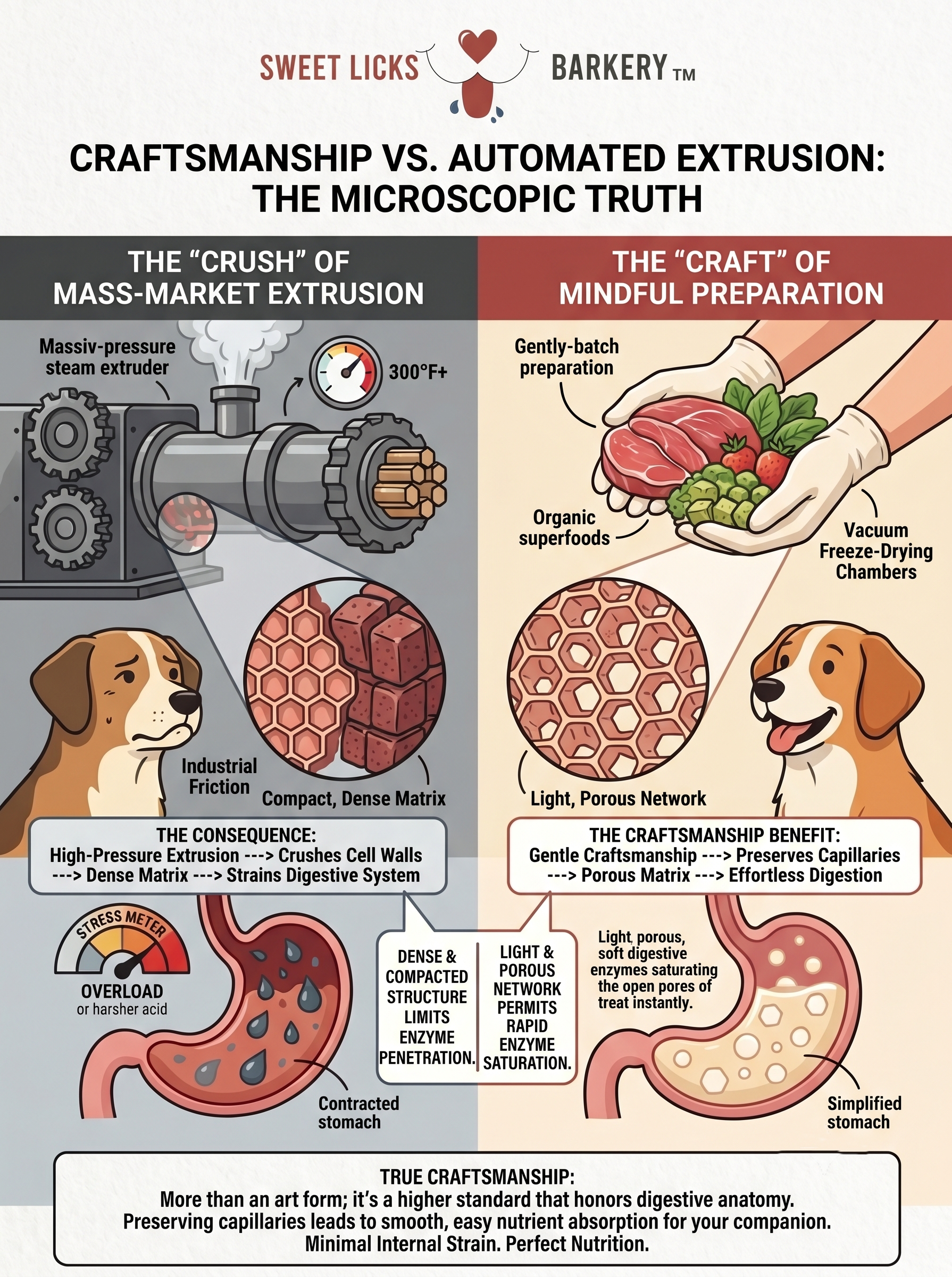
Automated extrusion requires feeding raw ingredients into a massive pressurized barrel where they are subjected to extreme mechanical friction, high-pressure steam injections, and intense shearing heat that frequently spikes past 300°F (Rokey et al., 2010). This harsh environment forces starches to gelatinize rapidly to bind the mixture together so it can be pushed through a shaping die at high velocity (Alavi et al., 2011).
While this method creates uniform shapes at remarkable speeds, the intense pressure completely shrivels and compacts the food's cellular matrix (Koppel et al., 2014). This physical compression creates a dense product that requires extended gastric transit times and significantly increased stomach acid production to break down inside the animal's gastric cavity (Case et al., 2011).
The Craftsmanship Advantage
Our manual formulation process avoids this physical compaction completely. By handling our farm to bowl muscle tissues and organic superfoods gently, we keep the food's natural cellular walls and delicate capillary channels perfectly intact (Montegiove et al., 2022). When these frozen ingredients enter our vacuum freeze-drying chambers, the moisture sublimates cleanly out of the tissue, leaving behind a light, porous network that fractures effortlessly under minimal jaw pressure.
High-Pressure Extrusion ---> Crushes Cell Walls ---> Dense Matrix ---> Strains Digestive System
Gentle Craftsmanship ---> Preserves Capillaries ---> Porous Matrix ---> Effortless Digestion
This open structure allows your pet's digestive enzymes to saturate the treat instantly, leading to smooth nutrient absorption and minimal internal strain (Case et al., 2011). Craftsmanship is more than an artistic choice; it is a superior manufacturing standard that honors your companion's digestive anatomy, ensuring every single bite delivers clean, easily accessible nutrition.
References
Alavi, S., Rokey, G., & Ekong, U. (2011). Extrusion processing of dry pet foods. FeedTech, 15(3), 22-25.
Case, L. P., Daristotle, L., Hayek, M. G., & Raasch, M. F. (2011). Canine and Feline Nutrition: A Resource for Companion Animal Professionals (3rd ed.). Mosby Elsevier.
Koppel, K., Gibson, M., Alavi, S., & Aldrich, G. (2014). The Effects of Cooking Process and Meat Inclusion on Pet Food Flavor and Texture Characteristics. Animals, 4(2), 254-271. https://doi.org/10.3390/ani4020254
Montegiove, N., Calzoni, E., Cesaretti, A., Pellegrino, R. M., Emiliani, C., Pellegrino, A., & Leonardi, L. (2022). The Hard Choice about Dry Pet Food: Comparison of Protein and Lipid Nutritional Qualities and Digestibility of Three Different Chicken-Based Formulations. Animals, 12(12), 1538. https://doi.org/10.3390/ani12121538
Rokey, G. J., Plattner, B., & Soukup, J. (2010). Feed extrusion process description. Revista Brasileira de Zootecnia, 39, 510-518. https://doi.org/10.1590/S1516-35982010001300055