
Defining Small-Batch
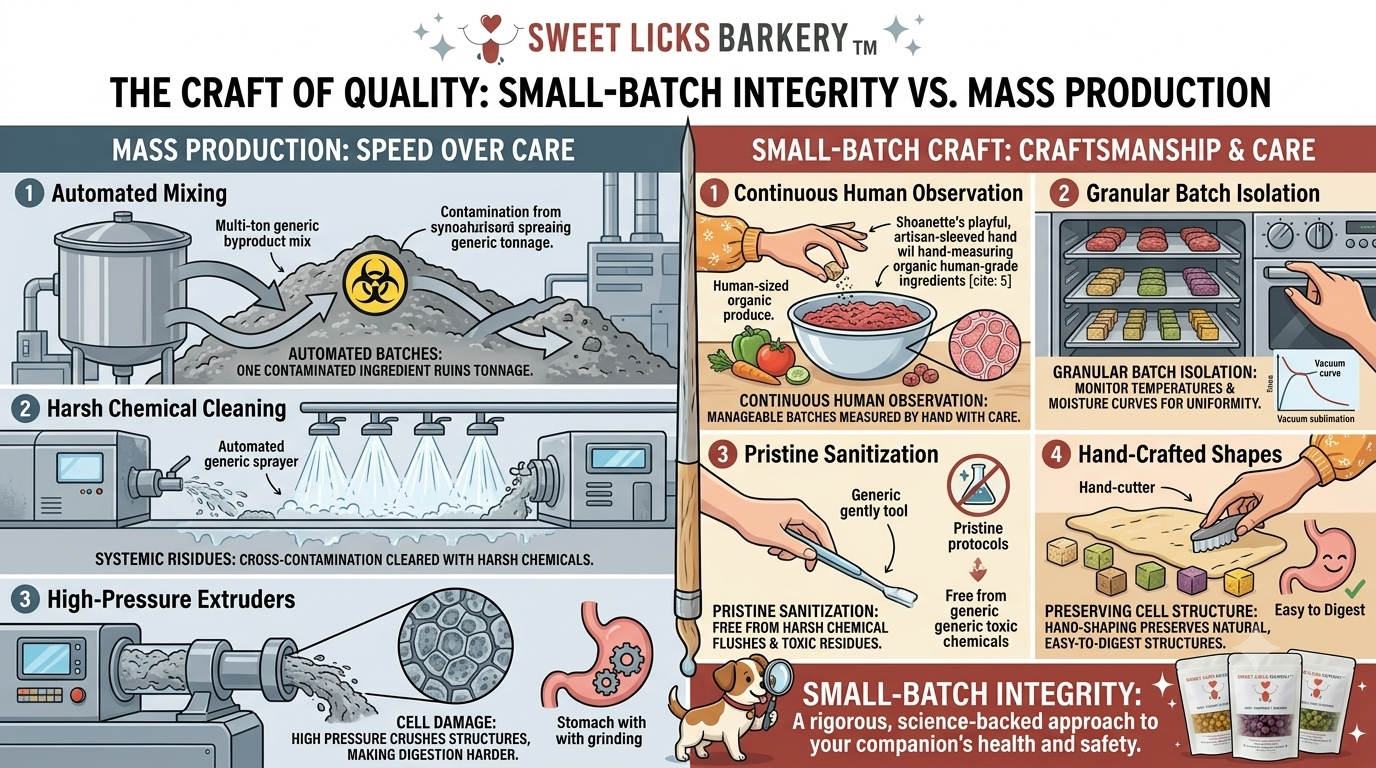
The Small-Batch Standard vs. Automated Factory Friction
The Small-Batch Standard vs. Automated Factory Friction
In the language of industrial manufacturing, "efficiency" is often code for automation, speed, and massive volume. For large-scale pet food manufacturers, producing millions of pounds of food per week requires highly automated, fast-moving assembly lines that operate under extreme mechanical stress (Rokey et al., 2010). In these massive operations, raw materials are handled as bulk commodities, and individual quality control is traded for automated sensory software.
At Sweet Licks Barkery, we choose a completely different approach, defining our operations through the disciplined practice of small-batch manufacturing integrity. We believe that true food safety and nutritional excellence require hands-on human craftsmanship and meticulous oversight at every step of the process.
The Vulnerability of Mass Production
To understand why small-batch production is so critical, we must look at the hidden vulnerabilities of large industrial factories. In high-velocity manufacturing facilities, raw ingredients are blended in massive, multi-ton vats where a single contaminated component can compromise an entire production run (LeJeune & Wetzel, 2007). Because these lines operate continuously, clearing out cross-contamination or mechanical residues requires the use of harsh chemical flushes that can leave behind micro-residues on the machinery.
Our small-batch kitchen completely eliminates these systemic risks:
Continuous Human Observation: We limit every single production run to manageable, carefully measured volumes that are prepared, cut, and loaded by hand under continuous human care.
Granular Batch Isolation: Crafting treats in isolated batches allows our team to monitor oven temperatures and vacuum sublimation curves with extreme precision, ensuring uniform moisture evacuation across every single piece (Lyons et al., 2009).
Pristine Sanitization Protocols: Because our kitchen does not handle low-grade byproduct meals or chemical texturizers, our sanitization processes remain clean, safe, and entirely free from toxic chemical residues.
The Craftsmanship Advantage
Manual preparation avoids the heavy mechanical compression common to automated factory extruders (Alavi et al., 2011). When raw ingredients are forced through high-pressure machines, the delicate cellular matrices of the food are crushed and packed down, creating a dense product that requires extra stomach acid and enzymatic effort to break down inside the gastric cavity (Case et al., 2011).
By handling our ingredients gently and shaping them by hand, we preserve the natural, open cell structure of the proteins, making them incredibly easy for your pet to digest. Small-batch integrity is not about nostalgia; it is a rigorous, science-backed approach to manufacturing that places your pet's internal health and safety above corporate processing speeds.
References
Alavi, S., Rokey, G., & Ekong, U. (2011). Extrusion processing of dry pet foods. FeedTech, 15(3), 22-25.
Case, L. P., Daristotle, L., Hayek, M. G., & Raasch, M. F. (2011). Canine and Feline Nutrition: A Resource for Companion Animal Professionals (3rd ed.). Mosby Elsevier.
LeJeune, J. T., & Wetzel, A. N. (2007). Preharvest contamination of poultry meat and eggs with Salmonella and Campylobacter. Animal Health Research Reviews, 8(2), 221-237. https://doi.org/10.1017/S146625230700133X
Lyons, W. J., Ben-Haim, Y., & Wood, R. (2009). Quality control optimization under severe uncertainty in small-batch food manufacturing. Journal of Food Process Engineering, 32(4), 512-531. https://doi.org/10.1111/j.1745-4530.2007.00229.x
Rokey, G. J., Plattner, B., & Soukup, J. (2010). Feed extrusion process description. Revista Brasileira de Zootecnia, 39, 510-518. https://doi.org/10.1590/S1516-35982010001300055