
The Local Multiplier Effect
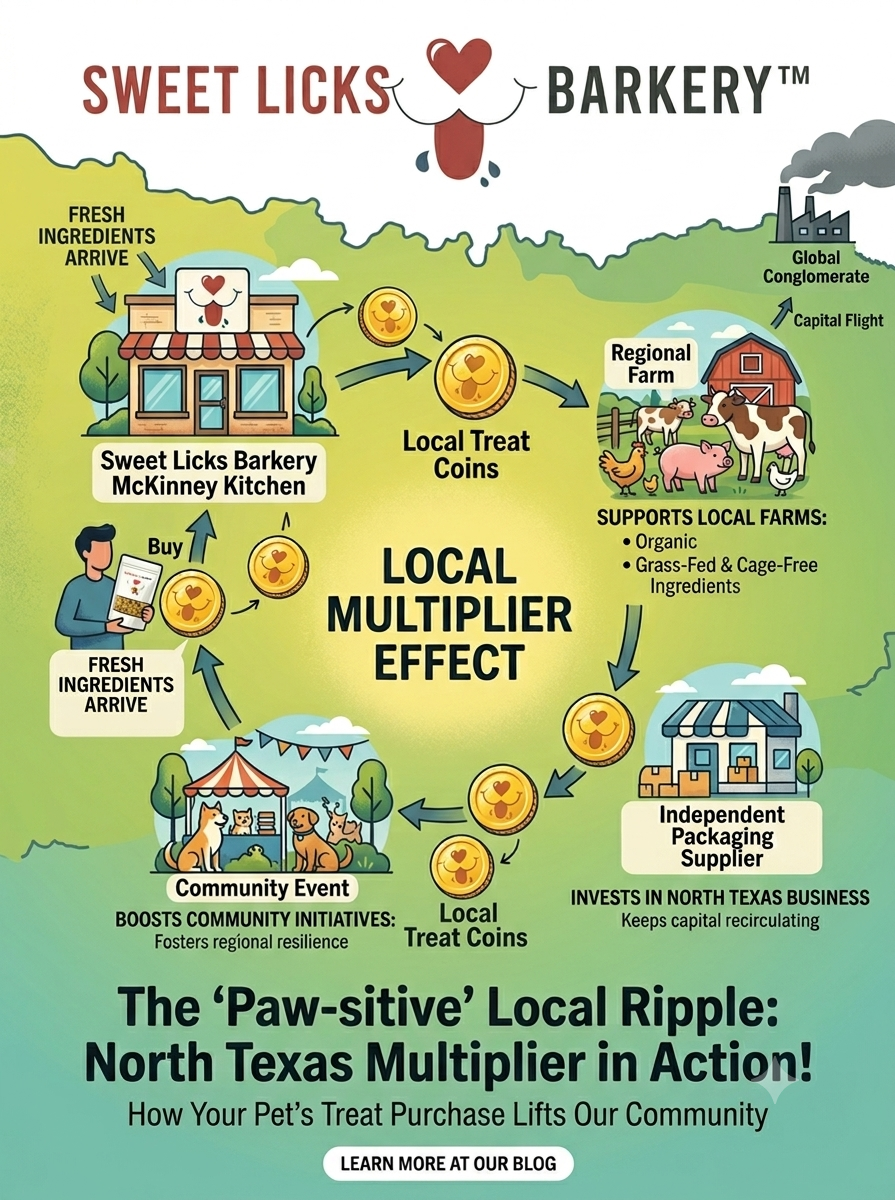
Regional Capital Flow: Sourcing via Sustainable Agriculture
Regional Capital Flow: Sourcing via Sustainable Agriculture
When evaluating the true footprint of a companion animal business, we must look beyond the physical ingredients inside the pouch and examine the financial and ecological networks that brought those ingredients to life. In a globalized economy, mass-market pet care brands rely on fragmented supply chains, moving raw materials across multiple continents and processing facilities before they ever reach a retail shelf (Martinez et al., 2010). This industrial model not only accelerates environmental degradation through extended shipping routes but also strips economic wealth from local communities.
Sweet Licks Barkery was established to pioneer an alternative system. Operating as an independent McKinney, Texas business, our operational architecture relies on a foundational economic principle called the Local Multiplier Effect (Martinez et al., 2010).
Understanding the Local Multiplier
The Local Multiplier Effect measures the clean economic impact of keeping capital working within a regional ecosystem. When a consumer purchases a mass-produced treat from a multinational conglomerate, approximately 85 to 90 cents of every dollar leaves the local community instantly, flowing back to distant corporate headquarters, international shipping brokers, and centralized industrial distribution hubs.
In sharp contrast, when you buy a small-batch reward from an independent local producer, that revenue is recirculated regionally (Martinez et al., 2010). We use that capital to purchase raw proteins directly from regional farms, partner with independent packaging suppliers, and invest in local community initiatives. This creates an ongoing chain reaction of regional investment, supporting sustainable family farms and fostering independent business resilience across North Texas.
Freshness Through Local Proximity
Bypassing international logistics loops provides an invaluable nutritional advantage for your companion: time. Mass-produced items frequently spend months sitting in shipping reefers, ocean containers, and distribution warehouses, where exposure to temperature fluctuations causes delicate animal fats to experience slow lipid oxidation (Fritsch & Gale, 1977). This chemical breakdown destroys fat-soluble vitamins and generates volatile aldehydes that can alter palatability and cause digestive inflammation (Case et al., 2011).
By maintaining a localized farm to bowl procurement loop, our ingredients arrive at our McKinney kitchen at peak biological freshness. We process raw materials rapidly, locking in natural vitamins and active enzymes before they have a chance to degrade (Montegiove et al., 2022). Supporting a localized supply chain is more than an ethical community choice—it is a direct investment in the structural purity and nutritional integrity of your pet's food.
References
Case, L. P., Daristotle, L., Hayek, M. G., & Raasch, M. F. (2011). Canine and Feline Nutrition: A Resource for Companion Animal Professionals (3rd ed.). Mosby Elsevier.
Fritsch, C. W., & Gale, J. A. (2014). Hexanal as a measure of rancidity in low fat foods. Journal of the American Oil Chemists' Society, 54(6), 225-228. https://doi.org/10.1007/BF02655181
Martinez, S., Hand, M., Da Pra, M., Pollack, S., Ralston, K., Smith, T., Vogel, S., Newman, C., & Slattery, S. (2010). Local Food Systems: Concepts, Impacts, and Issues (ERR-97). U.S. Department of Agriculture, Economic Research Service.
Montegiove, N., Calzoni, E., Cesaretti, A., Pellegrino, R. M., Emiliani, C., Pellegrino, A., & Leonardi, L. (2022). The Hard Choice about Dry Pet Food: Comparison of Protein and Lipid Nutritional Qualities and Digestibility of Three Different Chicken-Based Formulations. Animals, 12(12), 1538. https://doi.org/10.3390/ani12121538