
Exposing Rendered Meat Meals: The Cost of Low-Grade Feed
Thermal Degradation: The Metabolic Waste of Feed-Grade Rendering
Thermal Degradation: The Metabolic Waste of Feed-Grade Rendering
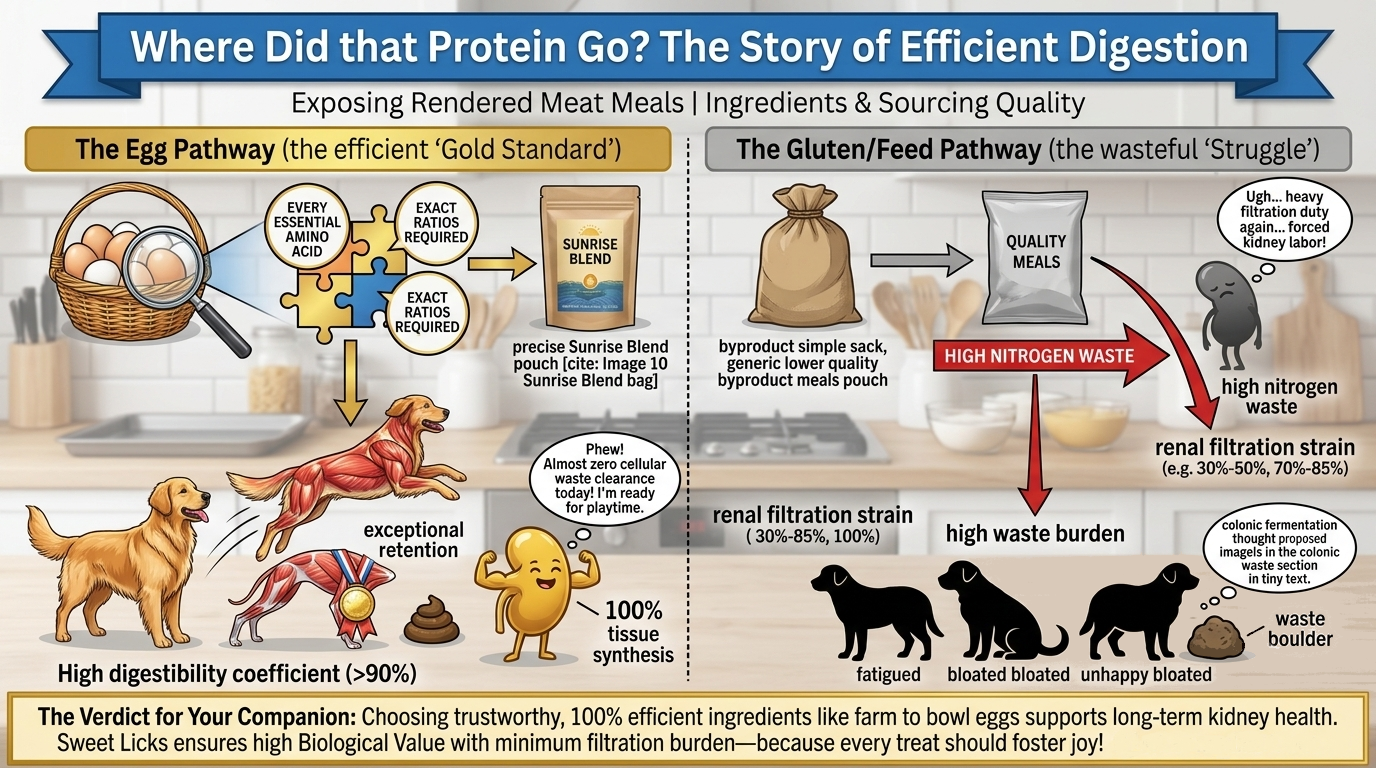
To truly safeguard the internal health of our companions, we must look past attractive front-of-bag marketing and critically evaluate the processing history of the proteins entering their systems. On mainstream pet treat labels, ingredients like "chicken meal," "poultry byproduct meal," or "meat and bone meal" frequently occupy top positions (Case et al., 2011). While commercial marketing positions these meals as highly concentrated protein sources, urological and gastrointestinal science reveals that rendered feed-grade meals carry a real metabolic cost for your pet (Montegiove et al., 2022).
At Sweet Licks Barkery, we ban rendered meat meals entirely from our kitchen, choosing instead to rely strictly on intact, un-rendered farm to bowl muscle tissues and whole superfoods.
The Chemistry of Industrial Rendering
To understand why rendered meals compromise your pet's health, we must examine the intense physical process of rendering. Meat meals are manufactured by gathering animal scraps, trimmings, and offal from high-confinement facilities and loading them into massive commercial vats (LeJeune & Wetzel, 2007). This material is subjected to hours of continuous high heat—often exceeding 250°F ($121^\circ\text{C}$)—under intense pressure to melt away fats and evaporate moisture until a dry, pulverized powder remains (Case et al., 2011).
While this harsh process succeeds in destroying pathogens, the prolonged heat exposure alters the natural shape of the protein cells (Montegiove et al., 2022). This chemical distortion triggers an irreversible reaction that links amino acids together into unnatural bonds, creating components like lysinoalanine that directly resist your pet's natural digestive enzymes (Case et al., 2011).
[Intact Muscle Tissue] ---> Smooth Enzymatic Breakdown ---> High Nutrient Absorption
[Rendered Meat Meals] ---> High-Heat Distortion ---> Lysinoalanine Bonds Block Enzymes ---> Strains Kidneys
The Burden on Filtration Organs
Because these heat-degraded proteins cannot be broken down or absorbed cleanly by the small intestine, they pass into the colon as undigested waste (Montegiove et al., 2022). This residue triggers rapid fermentation by harmful gut bacteria, resulting in persistent gas, soft stools, and bloating (Deng et al., 2016).
Furthermore, the fraction of distorted nitrogen that is absorbed cannot be smoothly used for skeletal tissue repair, forcing the liver and kidneys to work overtime to convert and filter out the waste as urea (Case et al., 2011).
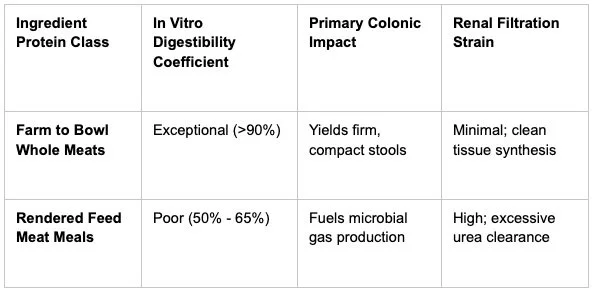
By choosing un-rendered farm to bowl whole meats and protecting them with our gentle freeze-drying process, Sweet Licks ensures your companion absorbs clean, easily accessible nutrients—minimizing digestive strain and keeping their filtration organs healthy for years to come (Lyons et al., 2009).
References
Case, L. P., Daristotle, L., Hayek, M. G., & Raasch, M. F. (2011). Canine and Feline Nutrition: A Resource for Companion Animal Professionals (3rd ed.). Mosby Elsevier.
Deng, P., Iwazaki, E., Suchodolski, J. S., Dowd, S. E., & Swanson, K. S. (2016). Effects of dietary protein concentration and source on fecal quality, microbiota, and metabolites in healthy adult cats. Journal of Animal Science, 94(6), 2419-2435. https://doi.org/10.2527/jas.2015-0210
LeJeune, J. T., & Wetzel, A. N. (2007). Preharvest contamination of poultry meat and eggs with Salmonella and Campylobacter. Animal Health Research Reviews, 8(2), 221-237. https://doi.org/10.1017/S146625230700133X
Lyons, W. J., Ben-Haim, Y., & Wood, R. (2009). Quality control optimization under severe uncertainty in small-batch food manufacturing. Journal of Food Process Engineering, 32(4), 512-531. https://doi.org/10.1111/j.1745-4530.2007.00229.x
Montegiove, N., Calzoni, E., Cesaretti, A., Pellegrino, R. M., Emiliani, C., Pellegrino, A., & Leonardi, L. (2022). The Hard Choice about Dry Pet Food: Comparison of Protein and Lipid Nutritional Qualities and Digestibility of Three Different Chicken-Based Formulations. Animals, 12(12), 1538. https://doi.org/10.3390/ani12121538