
Macromolecular Collapsing: Why Traditional Evaporation Shrivels Food Cells
Macromolecular Collapsing: Why Traditional Evaporation Shrivels Food Cells
To understand why a premium pet treat maintains its raw nutritional integrity over months of shelf storage, we must explore the physical chemistry of phase changes. All preservation methods focus on a single biological goal: lowering water activity to a threshold where foodborne pathogens and spoilage molds cannot access unbound water molecules to reproduce (Beuchat et al., 2013). However, the thermodynamic route a manufacturer takes to remove that water dictates the final structural and biochemical composition of the product (Ratti, 2001).
Traditional pet treats rely on thermal evaporation, while Sweet Licks Barkery utilizes solid-state vacuum sublimation to preserve the natural cellular footprint of our farm to bowl ingredients (Lyons et al., 2009).
The Degradation of Thermal Evaporation
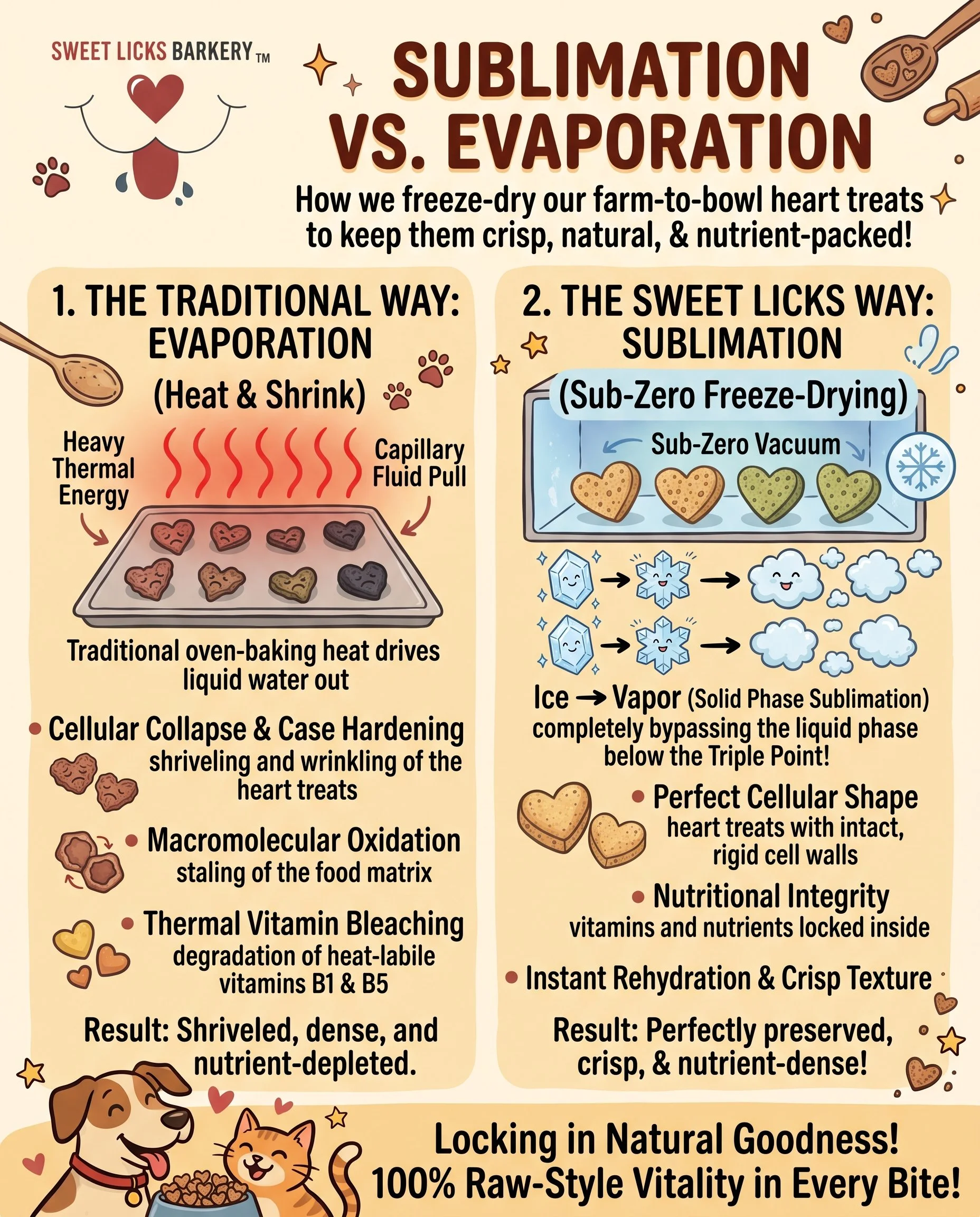
Traditional dehydration or oven-baking works by adding heavy thermal energy to drive liquid water into a gaseous state (Fellows, 2017). As heated air passes over raw meat cuts, surface moisture evaporates. This creates a moisture gradient that pulls internal liquid water outward through the cell walls via capillary forces (Fellows, 2017).
This constant movement of liquid water under high temperatures triggers several damaging processes:
Case Hardening and Cellular Collapse: The continuous exit of liquid water creates high surface tension that pulls the delicate cell walls inward, causing the food matrix to shrivel and shrink into a tough, leathery texture (Koppel et al., 2014).
Macromolecular Oxidation: Liquid water acts as a reactive solvent at elevated temperatures, accelerating the breakdown of natural animal lipids and generating volatile aldehydes that cause staling (Raharjo & Sofos, 1993).
Thermal Vitamin Bleaching: Prolonged exposure to heat breaks down sensitive, heat-labile vitamins like Thiamin ($B_1$) and Pantothenic Acid ($B_5$), degrading the food's natural nutritional value (Case et al., 2011).
The Thermodynamics of Sublimation
Freeze-drying avoids these heat-driven pitfalls completely by moving moisture through an entirely different physical phase change: sublimation. Sublimation is the direct transition of a substance from a solid state directly into a gaseous state, completely bypassing the liquid phase (Ratti, 2001). This phase change can only occur when the surrounding environmental pressure is manipulated below a precise thermodynamic boundary known as the triple point of water (Franks, 1998).
[Liquid Phase Evaporation] ---> Heat + Capillary Fluid Pull ---> Collapsed, Shriveled Cells (Dense Matrix)
[Solid Phase Sublimation] ---> Sub-Zero Vacuum Pressure ---> Intact, Rigid Cell Walls (Porous Matrix)
In our freeze-drying chambers, the atmospheric pressure is dropped well below the triple point marker ($611.65\text{ Pa}$ at $0.01^\circ\text{C}$). When gentle, calculated heat is introduced to the frozen trays, the trapped ice crystals do not melt into liquid water (Ratti, 2001). Instead, they sublimate directly into gaseous vapor, escaping through the natural pathways of the tissue without causing surface tension or cell wall stress (Ratti, 2001). Because the moisture escapes from a completely frozen state, the open cellular structure of our farm to bowl whole ingredients remains perfectly intact, delivering a crisp, highly digestible treat that rehydrates instantly (Montegiove et al., 2022).
References
Beuchat, L. R., Komitopoulou, E., Beckers, H., Betts, G. D., Bourdichon, F., Fanning, S., Joosten, H. M., & Ter Kuile, B. H. (2013). Low-water activity foods: Increased concern as vehicles of foodborne pathogens. Journal of Food Protection, 76(1), 150-172. https://doi.org/10.4315/0362-028X.JFP-12-211
Case, L. P., Daristotle, L., Hayek, M. G., & Raasch, M. F. (2011). Canine and Feline Nutrition: A Resource for Companion Animal Professionals (3rd ed.). Mosby Elsevier.
Fellows, P. J. (2017). Food Processing Technology: Principles and Practice (4th ed.). Woodhead Publishing.
Franks, F. (1998). Freeze-drying of bioproducts: Putting principles into practice. European Journal of Pharmaceutics and Biopharmaceutics, 45(3), 221-229. https://doi.org/10.1016/S0939-6411(98)00004-6
Koppel, K., Gibson, M., Alavi, S., & Aldrich, G. (2014). The Effects of Cooking Process and Meat Inclusion on Pet Food Flavor and Texture Characteristics. Animals, 4(2), 254-271. https://doi.org/10.3390/ani4020254
Lyons, W. J., Ben-Haim, Y., & Wood, R. (2009). Quality control optimization under severe uncertainty in small-batch food manufacturing. Journal of Food Process Engineering, 32(4), 512-531. https://doi.org/10.1111/j.1745-4530.2007.00229.x
Montegiove, N., Calzoni, E., Cesaretti, A., Pellegrino, R. M., Emiliani, C., Pellegrino, A., & Leonardi, L. (2022). The Hard Choice about Dry Pet Food: Comparison of Protein and Lipid Nutritional Qualities and Digestibility of Three Different Chicken-Based Formulations. Animals, 12(12), 1538. https://doi.org/10.3390/ani12121538
Raharjo, S., & Sofos, J. N. (1993). Lipid oxidation in oncology and agriculture meat products: A review. Meat Science, 35(2), 145-169. https://doi.org/10.1016/0309-1740(93)90051-G