
Physics of Thermal Destruction
The Physics of Thermal Destruction
Maintaining uncompromised food safety in a small-batch kitchen requires a precise understanding of the physical laws governing microbial survival. In the companion animal market, vague terms like "high quality" or "safely handled" are frequently tossed around without actual laboratory verification or scientific data. To protect our homes and our packs from foodborne illness, we must look past this basic marketing and examine the literal biochemistry of pathogen destruction.
At Sweet Licks Barkery, our preventative safety protocols are anchored in a fully validated thermal kill step, utilizing a precise temperature curve to ensure absolute public health safety in every single batch we hand-stamp (Lyons et al., 2009).
The Structural Weakness of Pathogen Cells
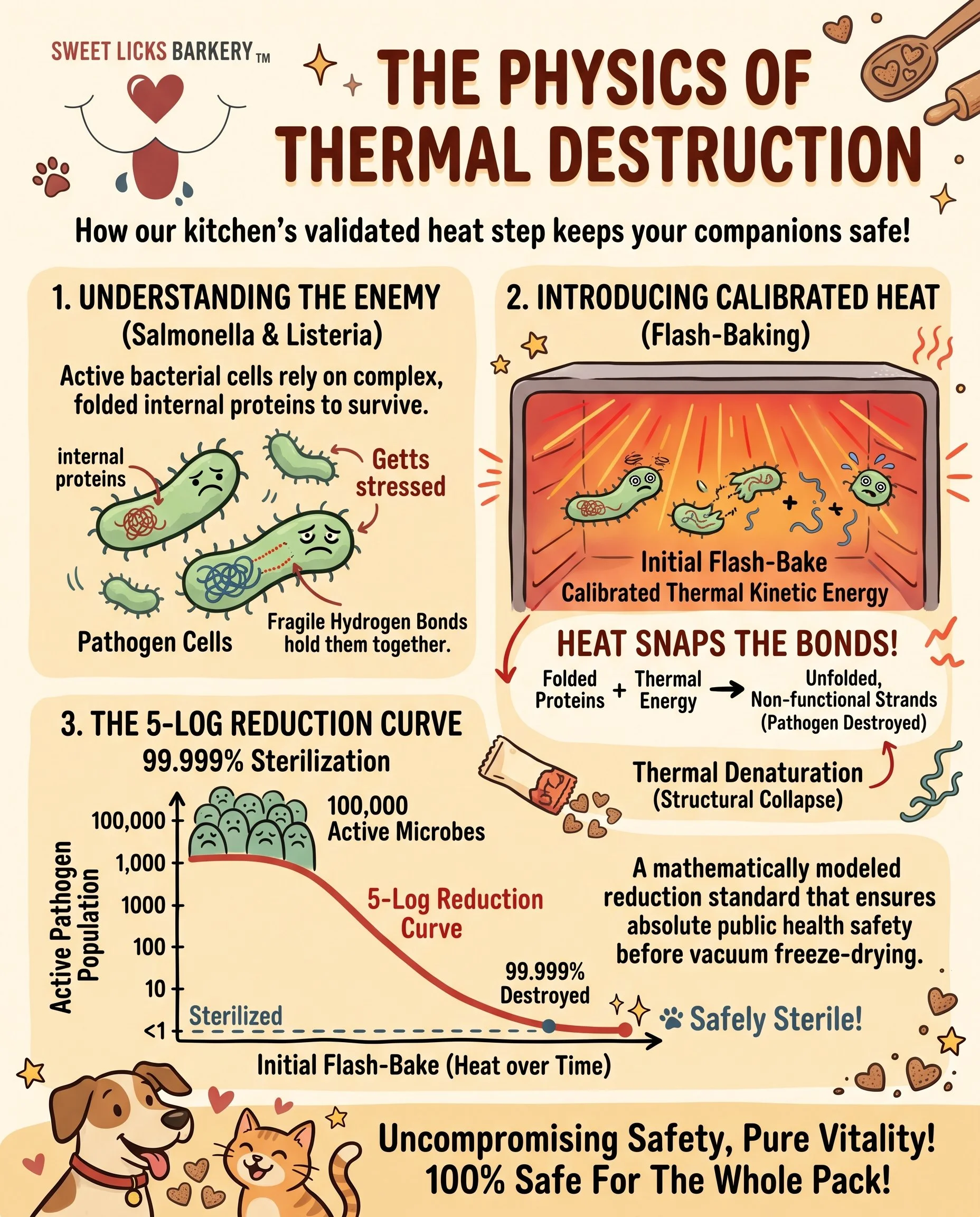
To understand how a thermal kill step functions, we must look at a bacterium like Salmonella or Listeria at a macromolecular level. A living bacterial cell depends on a highly complex system of internal proteins, functional enzymes, and double-stranded DNA to navigate metabolic cycles and replicate inside animal tissue (LeJeune & Wetzel, 2007). These internal proteins are held in their complex, folded configurations by weak hydrogen bonds and hydrophobic interactions (Fellows, 2017).
When uniform, calibrated heat is introduced during our initial flash-bake step, these weak chemical interactions are subjected to extreme kinetic stress (Fellows, 2017). The heat causes the atoms inside the bacterial proteins to vibrate rapidly, ultimately snapping the fragile hydrogen bonds holding the structures together.
Folded Functional Bacterial Protein + Calibrated Thermal Kinetic Energy ---> Unfolded, Denatured Strands (Pathogen Destroyed)
The Irreversible Path of Thermal Denaturation
This structural collapse, known as thermal denaturation, forces the folded protein strands to unwind and cross-link randomly into a non-functional mass (Fellows, 2017). This process permanently deforms the bacteria's vital metabolic enzymes and compromises their cell membrane integrity.
To guarantee that this cellular destruction is absolute across an entire batch run, our kitchen utilizes a mathematically modeled process called a 5-log reduction (Fellows, 2017). A 5-log reduction is a public health safety standard demonstrating that a thermal process has successfully destroyed 99.999% of a target pathogen population within a food matrix.
[100,000 Active Microbes] ---> Calibrated 5-Log Thermal Reduction Curve ---> Complete Systemic Sterilization (<1 Microbe Survives)
By hitting this strict scientific benchmark during our preliminary flash-bake step, we permanently deform pathogen structures before the treats ever enter our vacuum freeze-drying chambers (Lyons et al., 2009). This calculated approach ensures that your companion receives a pure, nutrient-dense reward that delivers outstanding raw-style vitality while completely eliminating the health risks of raw handling.
References
Fellows, P. J. (2017). Food Processing Technology: Principles and Practice (4th ed.). Woodhead Publishing.
LeJeune, J. T., & Wetzel, A. N. (2007). Preharvest contamination of poultry meat and eggs with Salmonella and Campylobacter. Animal Health Research Reviews, 8(2), 221-237. https://doi.org/10.1017/S146625230700133X
Lyons, W. J., Ben-Haim, Y., & Wood, R. (2009). Quality control optimization under severe uncertainty in small-batch food manufacturing. Journal of Food Process Engineering, 32(4), 512-531. https://doi.org/10.1111/j.1745-4530.2007.00229.x