
The Molecular Weight Threshold: Navigating Hydrolyzed Diets with Pure Intact Proteins
When a veterinarian prescribes a strict, prescription hydrolyzed diet to manage your companion’s chronic skin scratching, hot spots, or recurring gastrointestinal distress, it can feel like a complete nutritional lockdown. For many dedicated pet parents, the immediate realization that standard biscuits, chews, and table rewards are suddenly banned brings a wave of behavioral frustration. You are left wondering if your pet is destined to spend the rest of their life eating nothing but processed, industrially altered kibble.
To safely expand an allergy-prone dog's menu, we have to look past the front-of-bag marketing and examine the microscopic world of protein molecular weights, antibody cross-linking, and manufacturing biosecurity (Cave, 2006).
The Immunology of the Allergy Doorway
Food hypersensitivities are not general digestive failures; they are high-speed errors driven by your pet's immune system. In an allergic dog, specialized defense cells called mast cells—located throughout the skin, ears, and gut lining—become heavily coated with specialized target keys called Immunoglobulin E (IgE) antibodies (Cave, 2006).
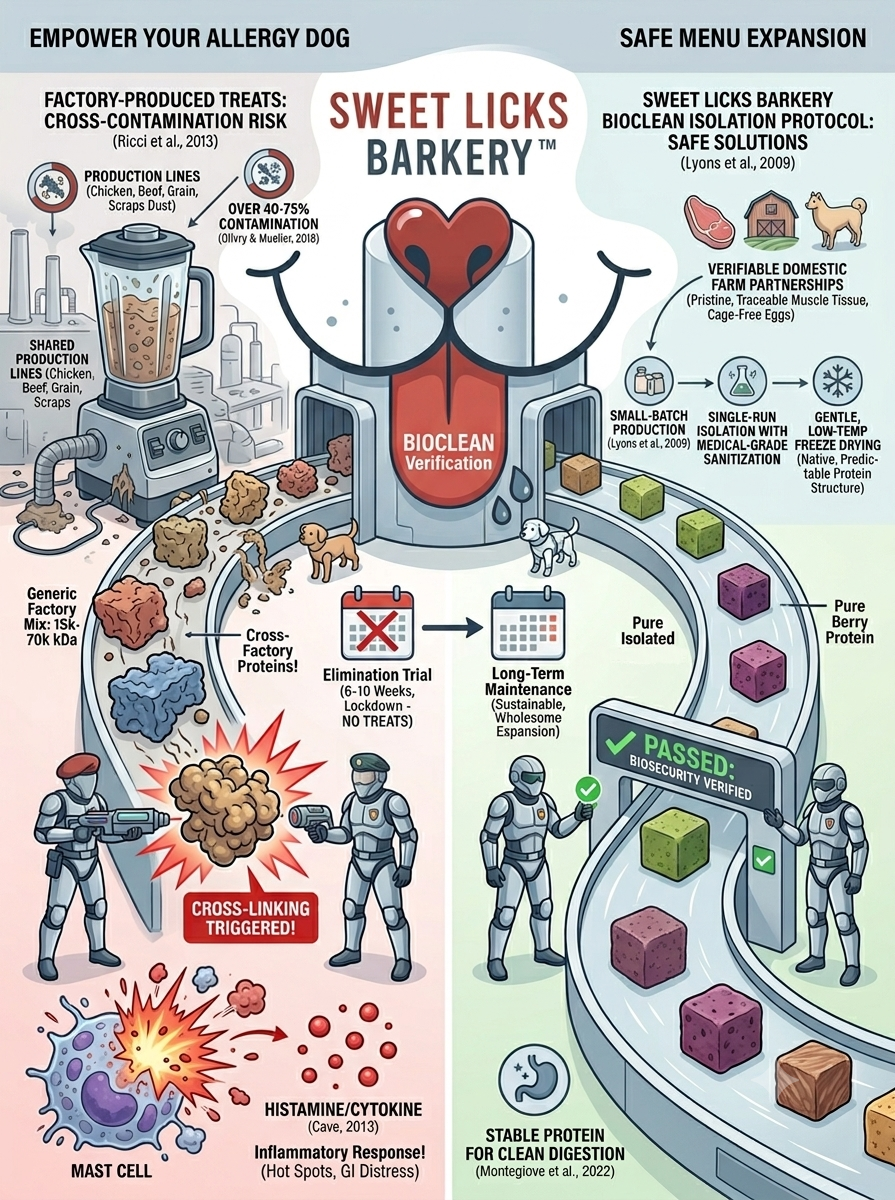
For an allergic reaction to explode, an ingested protein must possess a specific physical mass. It has to be large enough to span the physical distance between two separate IgE keys, bridging them together in a mechanical event known as antibody cross-linking (Cave, 2006). This cross-linking deforms the surface $Fc\epsilon RI$ receptors, telling the mast cell to burst open instantly and flood the surrounding tissues with an irritating surge of histamines and inflammatory cytokines (Cave, 2013).
Intact Protein (Large Mass) ---> Cross-Links Adjacent IgE Keys ---> Receptor Deformation ---> Explosive Histamine Outpour
Prescription hydrolyzed foods use a process called enzymatic hydrolysis to cheat this immune doorway. By subjecting raw materials to active protease enzymes, the factory clips the strong peptide bonds, shattering large intact proteins (which typically weigh between $15,000\text{ and } 70,000\text{ Daltons}$) into tiny microscopic fragments measuring well below the 10,000 Dalton (10 kDa) immune visibility threshold (Cave, 2006). Because these tiny fragments are too small to bridge the gap between IgE antibodies, they slip past your pet's internal defenses completely undetected.
           ==================================================================
                                                       PROTEIN IMMUNOLOGICAL VISIBILITY SCALE
           ==================================================================
            MOLECULAR MASS             | STRUCTURAL CONFIG.                                      | MAST CELL PROFILE
           ----------------------+-------------------------------------+------------------------
            Intact Proteins                   | Large, complex 3D                                           | Dangerous; cross-links
            (15 - 70 kDa)                      | macromolecular amino                                 | IgE keys to trigger
                                                          | acid strands                                                      | histamine outpour
           ----------------------+-------------------------------------+------------------------
            Hydrolyzed Peptides        | Broken, microscopic                                        | Invisible; slips past
            (< 10 kDa)                            | peptide fragments and                                  | immune gates without
                                                          | free amino acids                                              | receptor cross-linking
           ==================================================================
The Diagnostics Window: Elimination Trials vs. Maintenance
To determine whether a novel, intact protein treat can safely integrate with a hydrolyzed routine, you must first define your current veterinary timeline:
Phase 1: The Diagnostic Elimination Trial (Strict Lockdown)
If your companion is currently in the middle of a strict 6-to-10-week diagnostic elimination diet trial to identify active food triggers, you must not introduce any outside treats, including high-purity single proteins (Loeffler et al., 2004). During this diagnostic window, your vet requires an absolute baseline. Introducing an un-hydrolyzed protein configuration can confuse the trial results, forcing you to restart the multi-week timeline from scratch if symptoms flare up (Loeffler et al., 2004).
Phase 2: The Long-Term Maintenance Window (The Menu Expansion)
Once the diagnostic trial ends and your pet transitions into a long-term maintenance phase, your goal shifts from isolation to sustainable, wholesome nourishment. While hydrolyzed kibbles provide an excellent safety net, they are heavily processed and frequently rely on synthetic additives.
At this point, introducing an isolated, intact novel protein—a pure meat source your pet's ancestry has never encountered—can safely expand their diet, satisfying their natural urge to chew without triggering historical immune loops (Cave, 2006).
The Industrial Blindspot: The Cross-Contamination Threat
The primary risk associated with feeding over-the-counter single-protein rewards to an allergic pet is not the meat listed on the front of the bag; it is the hidden residue trapped inside. Advanced microarray DNA evaluations of commercial pet food plants have revealed that over 40% to 75% of conventional single-protein treats suffer from severe, unlisted cross-contamination (Ricci et al., 2013; Olivry & Mueller, 2018).
Massive automated factories pump tons of chicken, beef, and grain flours through identical blending vats and packaging equipment without thorough cleaning blocks.
Shared Factory Blender ---> Residual Chicken Scraps Bleed ---> Runny Batch Contaminated ---> Accidental IgE Binding
If your companion is highly sensitive to chicken, a single microscopic molecule of chicken dust left behind on a shared processing line can accidentally cross-link their IgE antibodies, triggering full mast cell degranulation even if the bag is labeled as 100% pure venison or rabbit (Ricci et al., 2013).
The Sweet Licks Biosecurity Isolation
Sweet Licks Barkery eliminates this hidden cross-contamination risk at its physical source. We operate on a strict small-batch kitchen philosophy inside our McKinney, Texas facility, treating protein isolation as an absolute biosecurity protocol rather than a basic manufacturing task (Lyons et al., 2009).
[Pristine Raw Material Lots] ──► [Sanitized Single-Run Kitchen] ──► [Sub-Zero Vacuum Sublimation]
Absolute Sourcing Transparency: We completely bypass anonymous global commodity brokers and industrial rendering plants, sourcing our muscle tissues and fresh eggs strictly through direct, verifiable domestic farm partnerships (Martinez et al., 2010).
Sanitized Single-Run Isolation: Our kitchen floor runs single-protein independent cycles with comprehensive, medical-grade breakdown sanitations between every batch, guaranteeing that our isolated recipes remain entirely free from unlisted animal scrap cross-contamination (Lyons et al., 2009).
Gentle Low-Temperature Sublimation: By utilizing sub-zero vacuum freeze-drying, we extract water weight without using intense factory heat, keeping the native novel amino acid structures perfectly stable and recognizable to support clean, predictable digestion (Ratti, 2001; Montegiove et al., 2022).
If your companion has completed their diagnostic lockdown and is ready for real whole-food enrichment, you can confidently partner with our clean, isolated flavor profiles to bring ancestral variety back to their bowl—safely, predictably, and honestly (Case et al., 2011; Montegiove et al., 2022).
References
Case, L. P., Daristotle, L., Hayek, M. G., & Raasch, M. F. (2011). Canine and Feline Nutrition: A Resource for Companion Animal Professionals (3rd ed.). Mosby Elsevier.
Cave, N. J. (2006). Hydrolyzed protein diets for dogs and cats. Veterinary Clinics of North America: Small Animal Practice, 36(6), 1251-1268. https://doi.org/10.1016/j.cvsm.2006.08.008
Cave, N. J. (2013). Nutritional management of gastrointestinal diseases. In Applied Veterinary Clinical Nutrition (pp. 195-218). Wiley-Blackwell.
Loeffler, A., Lloyd, D. H., Bond, R., Kim, J. Y., & Pfeiffer, D. U. (2004). Dietary trials with a commercial hydrolysed poultry diet, a home-cooked diet and a commercial novel-protein diet in dogs with pruritic keratoseborrheic dermatitis. Veterinary Record, 154(17), 519-522.
Lyons, W. J., Ben-Haim, Y., & Wood, R. (2009). Quality control optimization under severe uncertainty in small-batch food manufacturing. Journal of Food Process Engineering, 32(4), 512-531.
Martinez, S., Hand, M., Da Pra, M., Pollack, S., Ralston, K., Smith, T., Vogel, S., Newman, C., & Slattery, S. (2010). Local Food Systems: Concepts, Impacts, and Issues (ERR-97). U.S. Department of Agriculture, Economic Research Service.
Montegiove, N., Calzoni, E., Cesaretti, A., Pellegrino, R. M., Emiliani, C., Pellegrino, A., & Leonardi, L. (2022). The Hard Choice about Dry Pet Food: Comparison of Protein and Lipid Nutritional Qualities and Digestibility of Three Different Chicken-Based Formulations. Animals, 12(12), 1538.
Olivry, T., & Mueller, R. S. (2018). Critically appraised topic on adverse food reactions of companion animals (5): Discrepancies between ingredients and labels in commercial therapeutic and over-the-counter diets for dogs and cats. BMC Veterinary Research, 14(1), 24. https://doi.org/10.1186/s12917-018-1346-y
Ratti, C. (2001). Hot air and freeze-drying of high-value foods: A review. Journal of Food Engineering, 49(4), 311-319.
Ricci, R., Granato, A., Vascellari, M., Boscarato, M., Palagiano, C., Andrighetto, I., Diez, M., & Mutinelli, F. (2013). Identification of undeclared sources of animal origin in canine dry foods used in dietary elimination trials. Journal of Animal Physiology and Animal Nutrition, 97(s1), 32-38.