
Sourcing Standards: The Human Food Supply Chain Grid
Sourcing Standards: The Human Food Supply Chain Grid
In the study of companion animal nutrition, the quality of a raw ingredient dictates its ultimate value to the body's tissues. While a product label might display a standard metric like "26% crude protein," that number tells only part of the story. It completely leaves out the ingredient's origin, its processing history, and its actual biological availability (Case et al., 2011). To truly protect your pet's health, we must look past basic percentages and evaluate the structural integrity of the food grid itself.
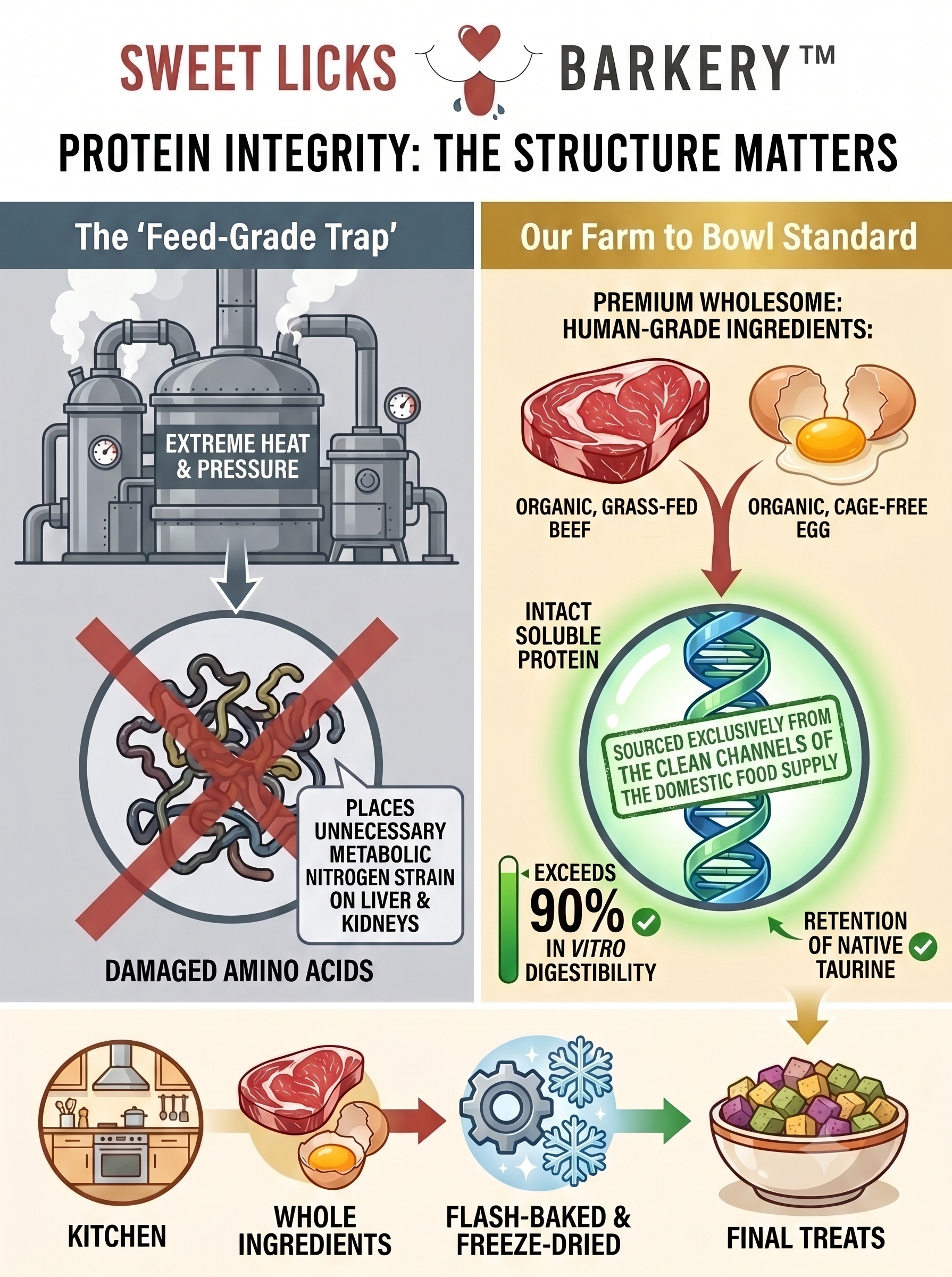
At Sweet Licks Barkery, we enforce a strict Farm to Bowl standard across our entire inventory. This means we completely reject feed-grade ingredients and low-grade byproducts, sourcing our single animal proteins exclusively from the clean channels of the domestic food supply chain, using only human-grade ingredients.
The Hidden Waste of Feed-Grade Material
To understand the value of farm to bowl sourcing, we must examine the alternative. Feed-grade ingredients are often composed of rendered meat meals and byproducts that are deemed unfit for clean supply chains. These materials are gathered from various commercial operations and subjected to intense industrial rendering—a process that uses extreme heat and pressure to separate fat from scrap tissue (Case et al., 2011).
While rendering destroys active pathogens, the prolonged high temperatures deform the natural shape of the protein strands, leading to a dilution of essential amino acids and a marked drop in biological value (Case et al., 2011). This intense processing creates a heat-damaged, low-grade material that places an unnecessary metabolic nitrogen strain on your pet's liver and kidneys as they work to filter out unabsorbable protein waste (Case et al., 2011).
Embracing Whole-Food Integrity
Sourcing directly from the farm to bowl grid ensures our kitchen receives whole muscle tissues and fresh eggs that have never undergone rendering or chemical texturizing. Analytical evaluations confirm that formulations utilizing fresh, un-rendered meats retain significantly higher concentrations of soluble protein, branched-chain amino acids, and native taurine compared to meal-based alternatives (Montegiove et al., 2022).
When your companion digests a farm to bowl treat, their digestive enzymes break down the protein with outstanding efficiency, achieving an in vitro digestibility score that exceeds 90% of its dry weight (Montegiove et al., 2022). This high availability ensures that essential amino acids move smoothly across the intestinal mucosal wall to support tissue repair, coat health, and daily immune defenses (Case et al., 2011). By choosing unadulterated whole foods, you bypass the hidden hazards of industrial rendering, providing your pet with clean fuel that supports their systemic vitality naturally.
References
Case, L. P., Daristotle, L., Hayek, M. G., & Raasch, M. F. (2011). Canine and Feline Nutrition: A Resource for Companion Animal Professionals (3rd ed.). Mosby Elsevier.
Montegiove, N., Calzoni, E., Cesaretti, A., Pellegrino, R. M., Emiliani, C., Pellegrino, A., & Leonardi, L. (2022). The Hard Choice about Dry Pet Food: Comparison of Protein and Lipid Nutritional Qualities and Digestibility of Three Different Chicken-Based Formulations. Animals, 12(12), 1538. https://doi.org/10.3390/ani12121538