
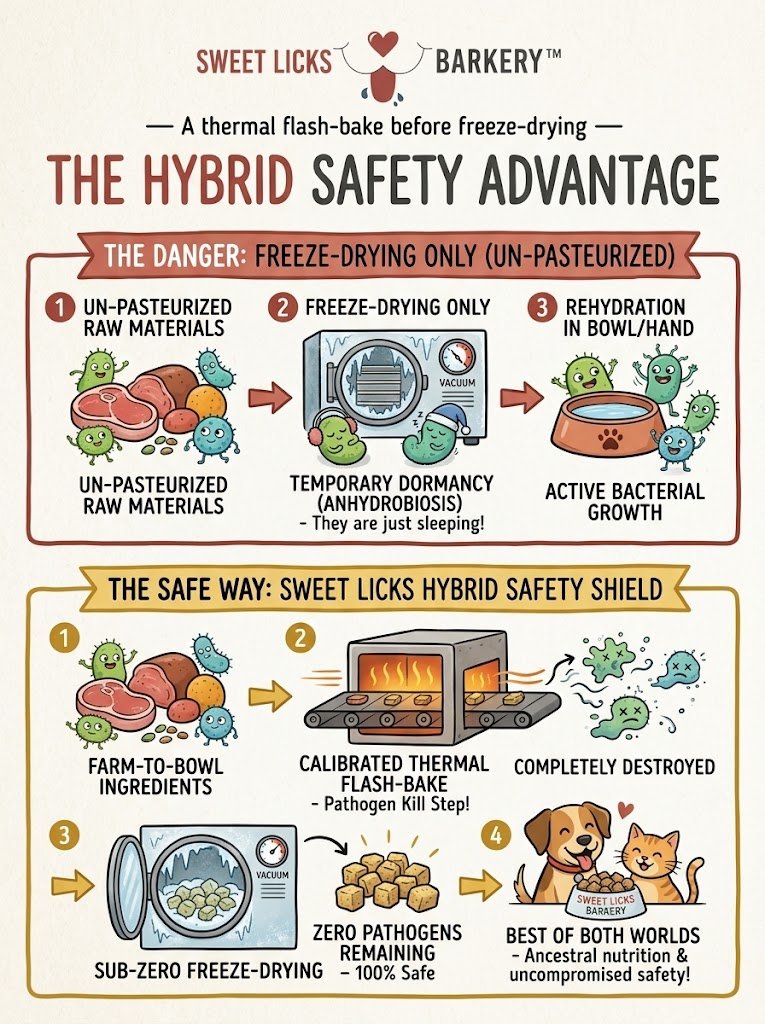
The Dormancy Hazard: Why Standard Freeze-Drying Fails to Sterilize
The Dormancy Hazard: Why Standard Freeze-Drying Fails to Sterilize
The popular rise of raw and minimally processed companion animal diets reflects a growing consumer desire to feed honest, whole foods that reflect ancestral canine and feline biology (Case et al., 2011). However, moving away from high-heat factory cooking requires a strict, scientifically validated approach to food safety. Many commercial brands rush completely raw animal tissues straight into freeze-drying chambers, assuming that sub-zero vacuum processing serves as an effective sterilization step.
A look at professional food microbiology reveals a hidden hazard: freeze-drying alone does not destroy pathogens; it merely forces them into a state of temporary metabolic dormancy (Beuchat et al., 2013). To eliminate this risk and protect your home, Sweet Licks Barkery implements a critical safety shield—a calibrated thermal flash-bake—before any ingredient enters the freeze-dryer.
The Biological Illusion of the Sub-Zero Vacuum
To understand why completely raw freeze-dried treats present a safety risk, we must examine how micro-organisms adapt to environmental changes. Pathogens like Salmonella, Listeria monocytogenes, and E. coli are remarkably resilient cellular structures (LeJeune & Wetzel, 2007). When subjected to the sub-zero temperatures and low pressure of a standard freeze-drying chamber, the water inside and around the bacteria is successfully removed through sublimation (Ratti, 2001).
However, this water removal does not destroy the bacteria's DNA or break its cellular walls (Beuchat et al., 2013). Instead, the lack of moisture simply triggers a protective survival state known as anhydrobiosis (Beuchat et al., 2013). The pathogens go dormant, waiting patiently inside the dry food matrix. The moment that un-pasteurized treat is handles by a pet parent, or mixed with warm water or saliva in the bowl, the dormant bacteria rehydrate instantly, reactivating their metabolic cycles and multiplying rapidly, which poses real public health risks (Beuchat et al., 2013).
Un-Pasteurized Raw Material ---> Freeze-Drying Only ---> Pathogens Go Dormant ---> Rehydrates in Bowl/Hand ---> Active Bacterial Growth
The Hybrid Safety Advantage
Sweet Licks Barkery completely eliminates this biological hazard through our specialized hybrid preparation process (Lyons et al., 2009). Before our farm to bowl ingredients enter the sub-zero lyophilization chambers, they undergo a rapid, high-precision thermal flash-bake (Lyons et al., 2009). This initial step functions as a fully validated pathogen kill step, applying uniform heat just long enough to permanently break down the delicate cell walls and internal proteins of target bacteria (Fellows, 2017).
+---------------------------------------------------------------------------------+
| MICROBIAL SAFETY PIPELINE ANALYSIS |
+--------------------+-----------------------------+------------------------------|
| PROCESSING METHOD | PATHOGEN CELLULAR STATUS | POST-REHYDRATION RISK PROFILE|
+--------------------+-----------------------------+------------------------------|
| Freeze-Drying Only | Pathogens enter protective | High; dormant bacteria wake |
| (Un-Pasteurized) | dormancy (Anhydrobiosis) | up and multiply rapidly in gut|
| Sweet Licks Hybrid | Complete thermal disruption | Zero; pathogens permanently |
| Flash-Bake Step | of bacterial cell structures| destroyed before processing |
+---------------------------------------------------------------------------------+
Once this pathogen shield is complete, the secured treats are moved directly into the vacuum chambers to complete their sublimation cycle (Ratti, 2001). This dual-stage process delivers the absolute best of both worlds: the strict, uncompromised public health safety of pasteurized food, combined with the outstanding enzyme density, vibrant aroma, and light texture of an ancestral raw diet.
References
Beuchat, L. R., Komitopoulou, E., Beckers, H., Betts, G. D., Bourdichon, F., Fanning, S., Joosten, H. M., & Ter Kuile, B. H. (2013). Low-water activity foods: Increased concern as vehicles of foodborne pathogens. Journal of Food Protection, 76(1), 150-172. https://doi.org/10.4315/0362-028X.JFP-12-211
Case, L. P., Daristotle, L., Hayek, M. G., & Raasch, M. F. (2011). Canine and Feline Nutrition: A Resource for Companion Animal Professionals (3rd ed.). Mosby Elsevier.
Fellows, P. J. (2017). Food Processing Technology: Principles and Practice (4th ed.). Woodhead Publishing.
LeJeune, J. T., & Wetzel, A. N. (2007). Preharvest contamination of poultry meat and eggs with Salmonella and Campylobacter. Animal Health Research Reviews, 8(2), 221-237. https://doi.org/10.1017/S146625230700133X
Lyons, W. J., Ben-Haim, Y., & Wood, R. (2009). Quality control optimization under severe uncertainty in small-batch food manufacturing. Journal of Food Process Engineering, 32(4), 512-531. https://doi.org/10.1111/j.1745-4530.2007.00229.x
Ratti, C. (2001). Hot air and freeze-drying of high-value foods: A review. Journal of Food Engineering, 49(4), 311-319. https://doi.org/10.1016/S0260-8774(00)00228-4