
Bypassing Dairy Derivatives: Sweet Licks Barkery
The Post-Weaning Lactase Deficit: Bypassing Gastrointestinal Distress
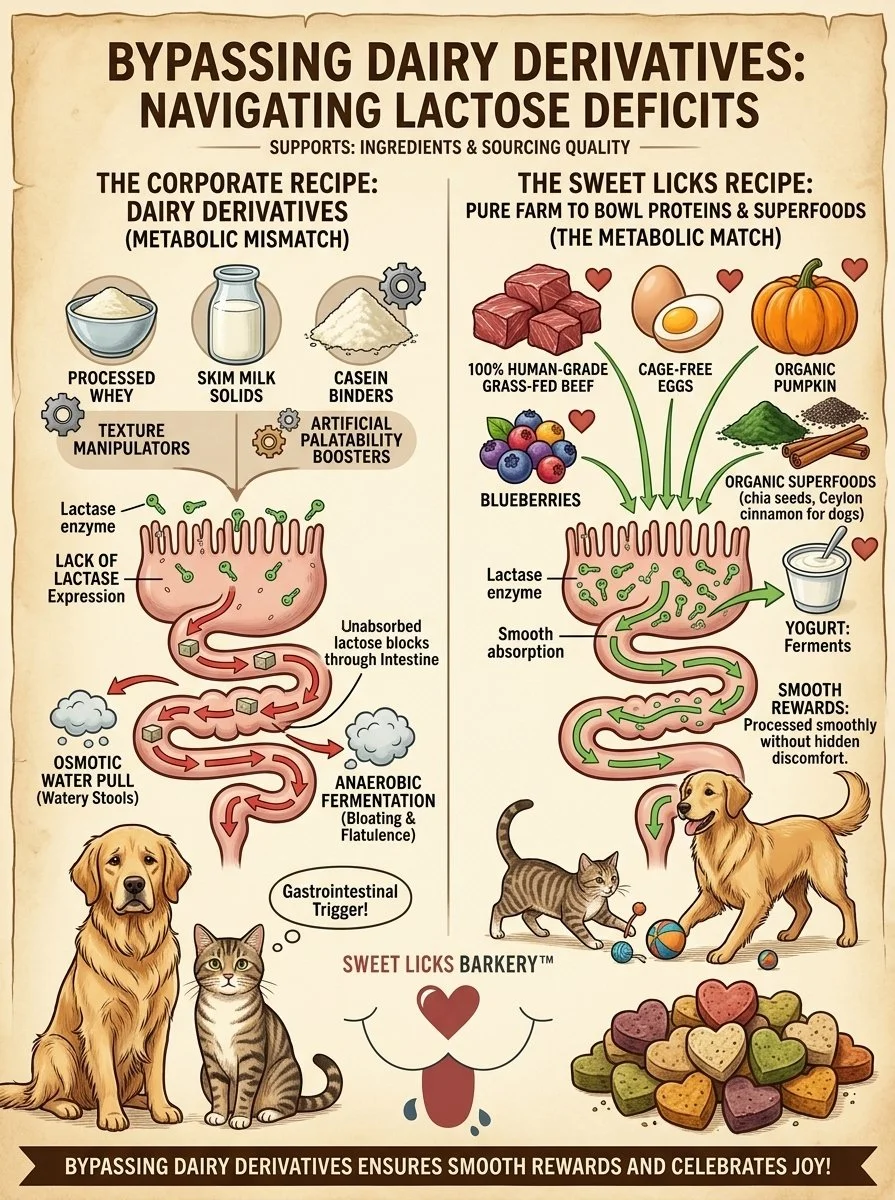
When evaluating ingredients for companion animal treats, dairy derivatives like processed whey, skim milk solids, and casein binders frequently appear in corporate recipes to manipulate texture and artificial palatability profiles. While these dairy components are easily tolerated by humans, applying them to adult dog and cat treats is a metabolic mismatch. Looking at the cellular development of the intestinal brush border reveals that companion animals possess a natural, permanent deficit that makes dairy ingredients a frequent source of digestive distress (National Research Council, 2006).
To keep digestion smooth and comfortable, Sweet Licks Barkery maintains a strict ban on all milk-based derivatives across our entire small-batch line.
The Post-Weaning Lactase Deficit
During infancy, nursing puppies and kittens produce abundant amounts of an essential brush-border enzyme called lactase along the microvilli of their small intestines (National Research Council, 2006). This specialized enzyme is required to split lactose—the primary disaccharide sugar found in milk—into simple sugars that can be absorbed safely into the blood.
However, as companion animals transition away from nursing and mature into adulthood, their bodies face a permanent biological shift:
Post-Weaning Maturation ———> leads to ———> Down-regulation of Intestinal Lactase Expression ———> leads to ———> Lactose Intolerance
Because adult dogs and cats lack the genetic programming to sustain high lactase production, any complex dairy sugars they consume pass through the small intestine completely undigested (National Research Council, 2006).
The Physics of Osmotic Distress
When unabsorbed lactose enters the large intestine, it alters the osmotic pressure within the bowel lumen. The dense sugar concentration pulls water molecules out of surrounding tissues and into the colon, causing watery, loose stools.
Simultaneously, resident colonic microflora eagerly attack the undigested sugars, triggering rapid anaerobic fermentation that releases volatile organic gases, leading to painful bloating, cramping, and flatulence.
Clinical Note: While yogurt contains some active ferments that assist with breakdown, the inclusion of un-fermented processed milk whey or texturizing caseins in dry pet treats represents a direct trigger for gastrointestinal disturbance.
By completely avoiding dairy fillers and building our treats around pure farm to bowl muscle meats and organic superfoods, Sweet Licks honors your pet's adult anatomy—ensuring every reward is processed smoothly without hidden digestive discomfort.
References
National Research Council (NRC). (2006). Nutrient Requirements of Dogs and Cats. National Academies Press. https://doi.org/10.17226/10668