
Science of a Premium Treat: Sweet Licks Barkery
The Sweet Licks Dual-Stage Method: Pasteurization Meets Sublimation
When choosing premium whole-food treats for your pack, pet parents frequently encounter two distinct styles of shelf-stable products: freeze-dried and traditional hot-air dehydrated. While both methods successfully preserve food by lowering internal moisture levels to stop bacterial spoilage, they rely on entirely different principles of physical chemistry and thermodynamics (Ratti, 2001). The way moisture is removed from raw muscle tissue directly shapes the final structure, nutrient retention, and digestibility of the treat (Fellows, 2017).
Exploring the physical science behind these processing methods reveals why vacuum freeze-drying offers an unmatched nutritional advantage for your companion's system.
The Dynamics of Hot-Air Dehydration
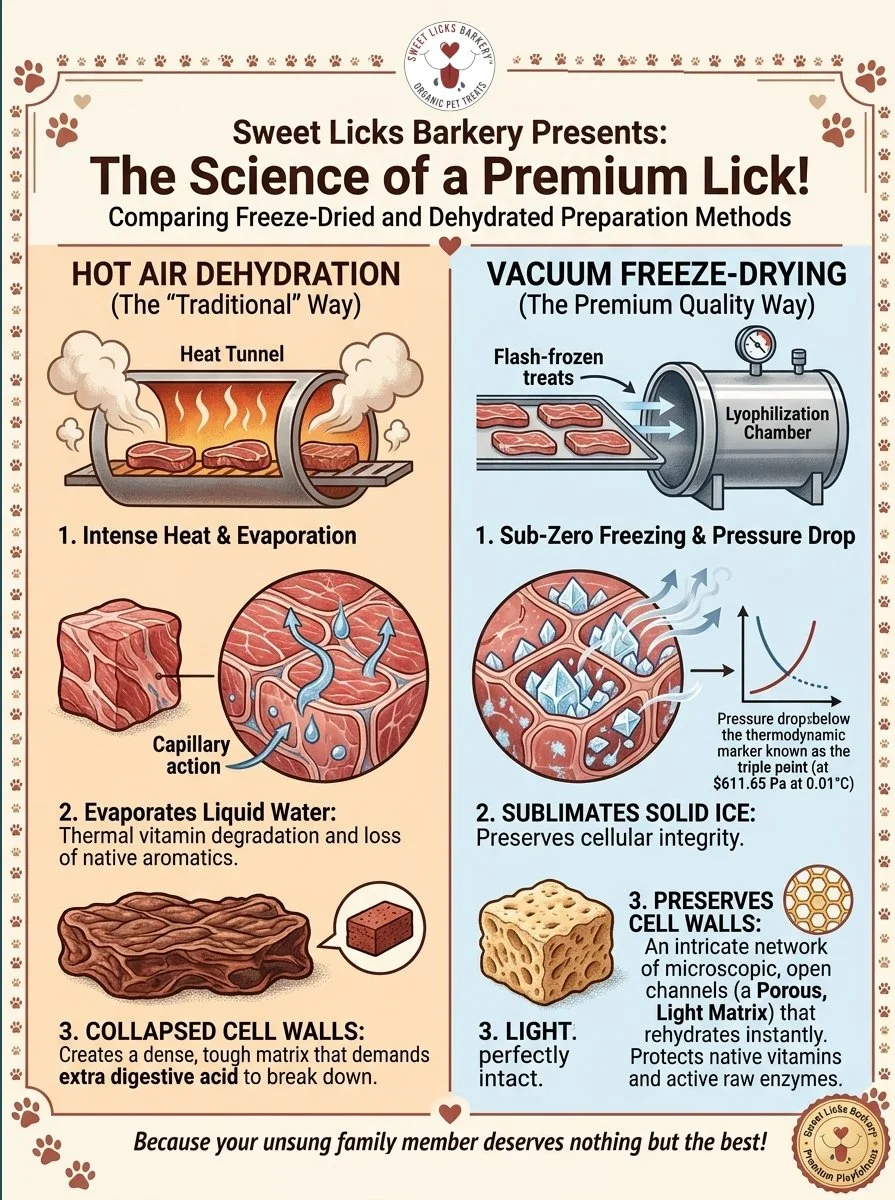
Traditional dehydration operates on the principle of thermal evaporation (Fellows, 2017). Raw meat cuts are placed inside heated tunnels where continuous streams of hot, dry air circulate to evaporate water molecules from the food's surface. As moisture evaporates, internal liquid water moves outward through the cell walls via capillary action to replace the lost surface fluids (Fellows, 2017).
While effective for shelf stability, this thermal process can compromise the food's structure and nutritional value:
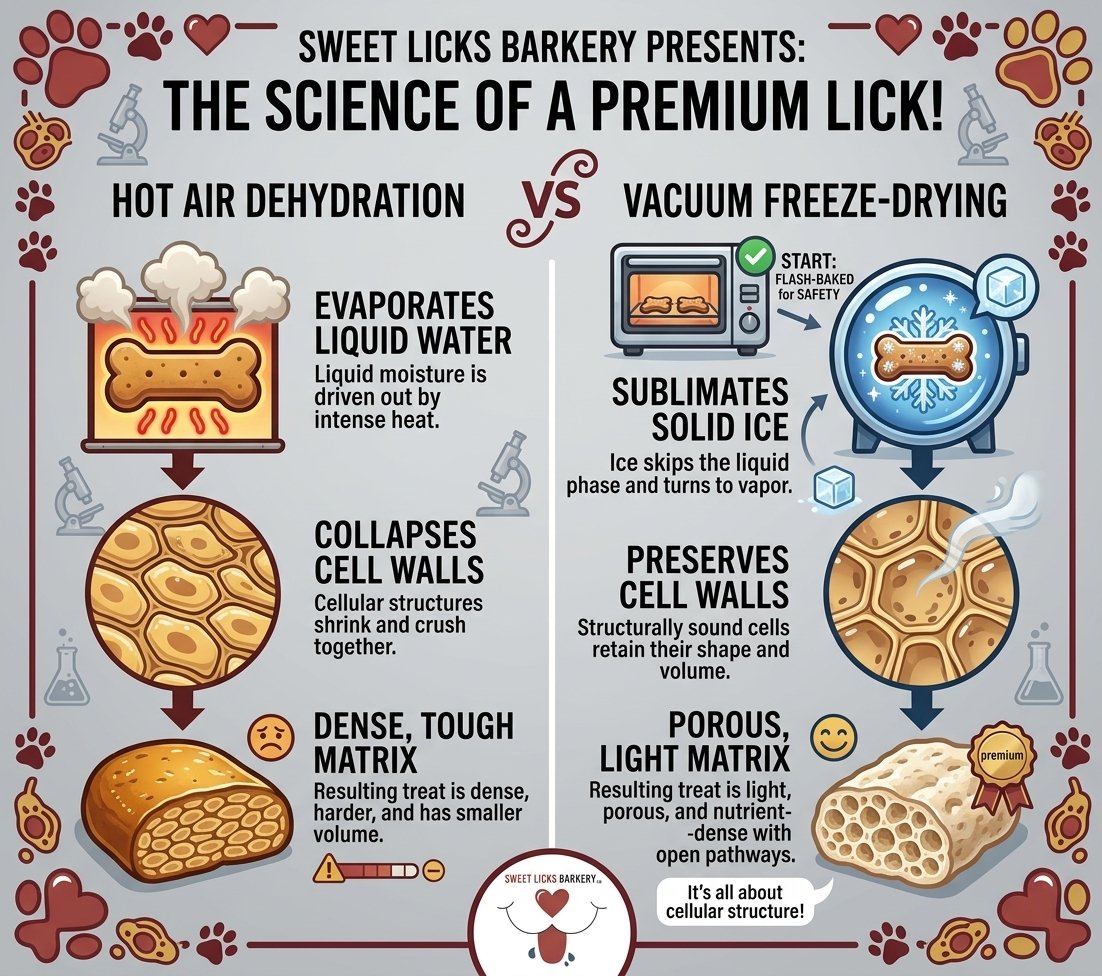
Severe Cellular Shrinkage: The continuous pull of liquid water causes the food's cellular walls to collapse and shrink inward, creating a hard, dense treat that demands extra digestive acid to break down inside the stomach (Koppel et al., 2014).
Thermal Vitamin Degradation: Prolonged exposure to hot air alters heat-labile vitamins (such as Thiamin and Vitamin E) and breaks down active raw enzymes (Case et al., 2011).
Loss of Native Aromatics: The constant flow of heated air carries away volatile organic compounds, reducing the food's natural, enticing aroma (Koppel et al., 2014).
The Thermodynamics of Solid Sublimation
Vacuum freeze-drying utilizes an advanced phase transition process called sublimation—the direct transformation of a substance from a solid ice state to a gaseous vapor state, completely bypassing the liquid phase (Ratti, 2001).
To achieve sublimation, our farm to bowl whole ingredients are frozen rapidly, locking every water molecule firmly inside a solid ice grid (Lyons et al., 2009). The treats are then placed into a sealed lyophilization chamber where powerful vacuum pumps drop the internal atmospheric pressure well below the thermodynamic marker known as the triple point of water ($611.65\text{ Pa}$ at $0.01^\circ\text{C}$).
Sub-Zero Freezing ———> Pressure Drop Below Triple Point ———> Ice Turns Directly Into Gas
With pressure held below this critical line, the ice cannot melt into liquid water (Ratti, 2001). Instead, when gentle, controlled thermal energy is applied to the trays, the trapped ice crystals sublimate directly into gaseous vapor, escaping cleanly through the food's pores (Ratti, 2001).
Science of Sweet Licks Barkery Treats
Because the ice transforms into gas from a completely frozen state, the structural walls of the meat cells remain perfectly rigid and uncompressed (Ratti, 2001). Freeze-drying leaves behind an intricate network of microscopic, open channels that preserve the exact shape, native vitamins, and active raw enzymes of the fresh whole food (Fellows, 2017). This creates a light, crispy treat that rehydrates instantly and delivers clean, easily accessible nutrition that honors your pet's ancestral system flawlessly (Case et al., 2011).
References
Case, L. P., Daristotle, L., Hayek, M. G., & Raasch, M. F. (2011). Canine and Feline Nutrition: A Resource for Companion Animal Professionals (3rd ed.). Mosby Elsevier.
Fellows, P. J. (2017). Food Processing Technology: Principles and Practice (4th ed.). Woodhead Publishing.
Koppel, K., Gibson, M., Alavi, S., & Aldrich, G. (2014). The Effects of Cooking Process and Meat Inclusion on Pet Food Flavor and Texture Characteristics. Animals, 4(2), 254-271. https://doi.org/10.3390/ani4020254
Lyons, W. J., Ben-Haim, Y., & Wood, R. (2009). Quality control optimization under severe uncertainty in small-batch food manufacturing. Journal of Food Process Engineering, 32(4), 512-531. https://doi.org/10.1111/j.1745-4530.2007.00229.x
Ratti, C. (2001). Hot air and freeze-drying of high-value foods: A review. Journal of Food Engineering, 49(4), 311-319. https://doi.org/10.1016/S0260-8774(00)00228-4